February 2026

Release period: February 1 – February 28, 2026
February built on January's launches by making them production-ready: web application scanning (DAST) matured fast with CLI-driven scans, evidence, and DOCX reports; AI Guardrails gained a policy framework and multi-tenant, parallelized scanning; and we introduced tagging across findings and vulnerabilities, separated threats into their own feed, and shipped a new agentless API discovery CLI.
Highlights
- Findings & Vulnerabilities tagging — Apply tags to findings and vulnerabilities to organize, triage, and filter at scale, with bulk delete and a redesigned Findings view.
- DAST scanning matures — Launch web app scans from the CLI, capture evidence, cancel scans end to end, export DOCX reports, and discover far more endpoints with new JS-aware crawling.
- AI Guardrail Policies — A new policy framework for AI Guardrails with multi-tenant enforcement and parallel scanning for 3–5x faster checks.
- Threats, separated from findings — Runtime threats now have their own dedicated feed, distinct from security findings.
- Agentless API discovery CLI — A new command-line tool to discover APIs with multiple scan modes, no sensor required.
- End-to-end audit logging — A rebuilt audit log with readable entity names, user-activity tracking, and before/after state on changes.
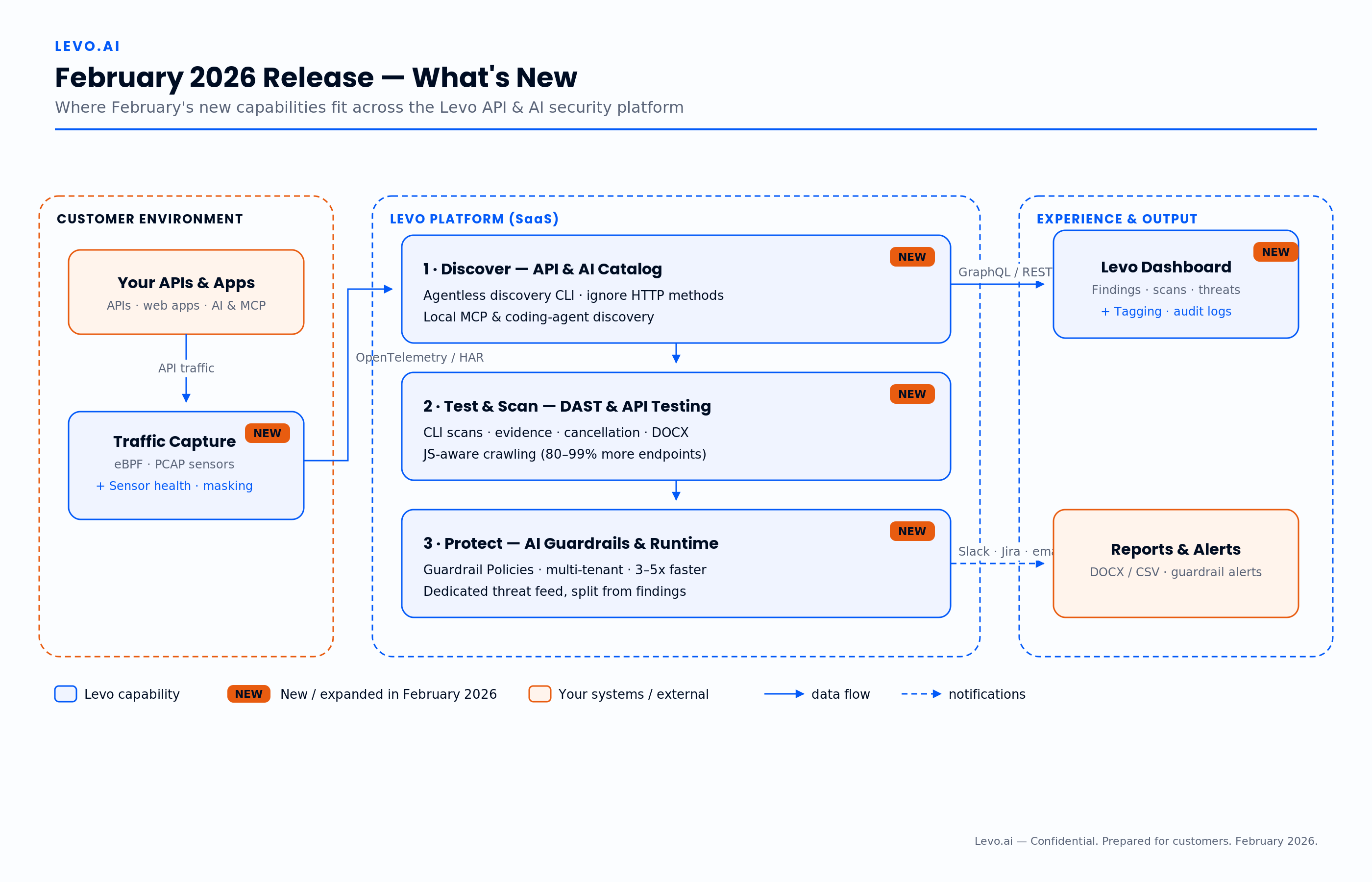
What's new at a glance. A map of where February's new capabilities fit across the Levo API & AI security platform.
Vulnerabilities & Findings
New Features
- Tagging for findings and vulnerabilities — Apply and search by tags across findings and vulnerabilities to organize and triage at scale.
- Bulk delete for findings — Select and remove multiple findings in one action.
- Redesigned Findings page — A new Findings view with clearer layout and additional row controls.
- Search for multiple issue names at once across the Findings and Grouped Findings screens.
- New KIND filter for findings and vulnerabilities, plus improved field filtering.
Resolved Issues
- Null values appear on the Grouped Findings page.
- The vulnerability detail page does not open for certain filters.
- The application-to-endpoints count does not match.
Web Application Scanning (DAST)
New Features
- Launch scans from the CLI — Kick off web application scans directly from the command line.
- Evidence capture — DAST scans now record supporting evidence for each finding, viewable in the UI.
- DOCX scan reports — Export web application scan results as DOCX, alongside an improved report export experience.
- Scan cancellation — Cancel a running web app scan end to end.
- AI-assisted login — Provide a prompt and credentials for AI-driven authentication during a scan.
- Smarter crawling and discovery — AI-driven crawler and prompt improvements, framework-agnostic URL discovery, and JS endpoint discovery that finds 80–99% more endpoints.
- Separate passive (Scanner) and active (Probe) interfaces, advanced rules in active scans, and new active-scan test categories including a SQL injection filter in the UI.
- Standard crawl mode is now the default when creating a scan, with a refreshed scan details page, metrics, and URLs tab.
Resolved Issues
- Scan logs are not cleaned up.
- LLM provider selection does not work correctly.
- Assorted scan stability issues.
AI Security
New Features
- AI Guardrail Policies — A new policy framework to configure AI Guardrails, with an expandable policy screen and per-scanner action and alert settings.
- Guardrail alert management API — New API endpoints to manage and route guardrail alerts.
- Standalone Scan API — Dedicated request and response scan endpoints for integrating guardrail checks directly.
- Multi-tenant guardrails — Multi-tenant guardrail management with per-tenant alert routing and OAuth2 token rotation.
- Faster guardrail scanning — Parallel scanner execution for 3–5x faster checks, plus a global model cache that cuts cold-start model load from ~40s to ~1s.
- Configurable alert webhooks and periodic scanner-configuration polling, with SaaS configuration enabled by default.
AI Discovery
New Features
- Local MCP and coding-agent discovery — Levo now discovers local MCP servers and coding agents, including those launched from the Claude CLI, and captures their enabled tools and permissions.
API Discovery & Cataloging
New Features
- Agentless API discovery CLI — A new command-line tool to discover APIs with multiple scan modes, without deploying a sensor.
- Auth scheme refresh — A new system capability to refresh authentication schemes for endpoints by replaying recent traffic.
- Configure API discovery to ignore specific HTTP methods, reducing noise in generated specs.
- Application-name support across discovery so endpoints are attributed to the right app, with faster API-visibility retrieval.
Resolved Issues
- Imported Postman collections are not persisted reliably.
- Optional path lists are handled incorrectly during discovery.
Runtime Protection
New Features
- Dedicated threat feed — Runtime threats are now separated from security findings into their own feed and UI, with new threat-ingestion endpoints.
- Production reliability, memory-safety, and client-identification improvements across the protection engine.
Sensitive Data
New Features
- Sensitive-data masking in trace collection — Trace collection can now mask sensitive values, with data-type-based masking applied during processing.
- Improved Sensitive Data page for both traces and endpoints, with Authentication and PII details separated on the endpoint detail page.
Resolved Issues
- A PII filter persists incorrectly in saved views.
Reporting & Compliance
New Features
- DOCX report generation — Generate DAST reports in DOCX format for sharing and offline review.
Sensors & Deployment
New Features
- Sensor health reporting — eBPF and PCAP sensors now capture health and component details and report them to the Satellite.
- eBPF sensor CPU optimizations and PCAP multitenant traffic support.
- New fallback handling so traffic is captured reliably across PCAP and other sensors.
API Security Testing
New Features
- Per-test error-code configuration — Define expected error codes for security tests to reduce false positives.
- Automatic baseline retry when authentication expires mid-run, for more reliable test results.
Integrations
Resolved Issues
- The Burp extension includes default ports (80 for HTTP, 443 for HTTPS) in the Host header, contrary to RFC 7230.
Platform, Administration & Access
New Features
- End-to-end audit logging — A rebuilt audit log that resolves entity IDs to readable names, tracks user activities, captures before/after state on changes, and supports querying by organization.
- POC workspace limits — Proof-of-concept workspaces are now capped at five applications via tier tagging, with a clear in-app banner.
- Standardized service-to-service communication and environment-scoped requests for more consistent, isolated multi-environment behavior, with improved connection stability at scale.
- Faster endpoint and application loading, database-level pagination, and page numbers retained when switching environments.
- Skeleton loaders, category titles in navigation, and clearer severity colors.
Resolved Issues
- Cached data persists incorrectly when switching organizations.
- Signing in with the wrong password gives an unintuitive experience.
- Assorted dashboard UI/UX issues.