March 2026

Release period: March 1 – March 31, 2026
March is a big month for web application scanning: our DAST engine matures with smarter crawling, scheduled and on-demand scans, AI/LLM-driven authentication, and a large round of false-positive reduction. We also unified AI Gateway policies with live guardrail enforcement, moved reporting to a faster async pipeline with a new application comparison report, and added configurable session management, sensor health notifications, and grouped threats.
Highlights
- DAST matures — Web application scans gain smart crawl depth, scheduled and re-runnable scans, deployable on-prem runners, OpenAPI spec parsing, and broad coverage of missing vulnerability categories — with a major false-positive cleanup across active and passive scanners.
- Unified AI Gateway policies — A consolidated, gateway-level policy architecture with hot-reloaded policies from SaaS, a forward-proxy AI traffic governance pipeline, and live guardrail scanners now enabled in the AI Firewall.
- Faster reporting with application comparison — Reports moved to an async pipeline for reliability at scale, plus a new application comparison report you can run and view in the dashboard.
- Configurable session management — Set inactivity and absolute session timeouts, with a clear banner explaining why a session ended.
- Sensor health notifications — Get notified when a sensor goes inactive, with configuration support so you know your traffic capture is healthy.
- Grouped threats and richer findings — Threats are now grouped for easier triage, with evidence surfaced in the Threat Feed, severity sorting, more filters, and saved views across findings and scans.
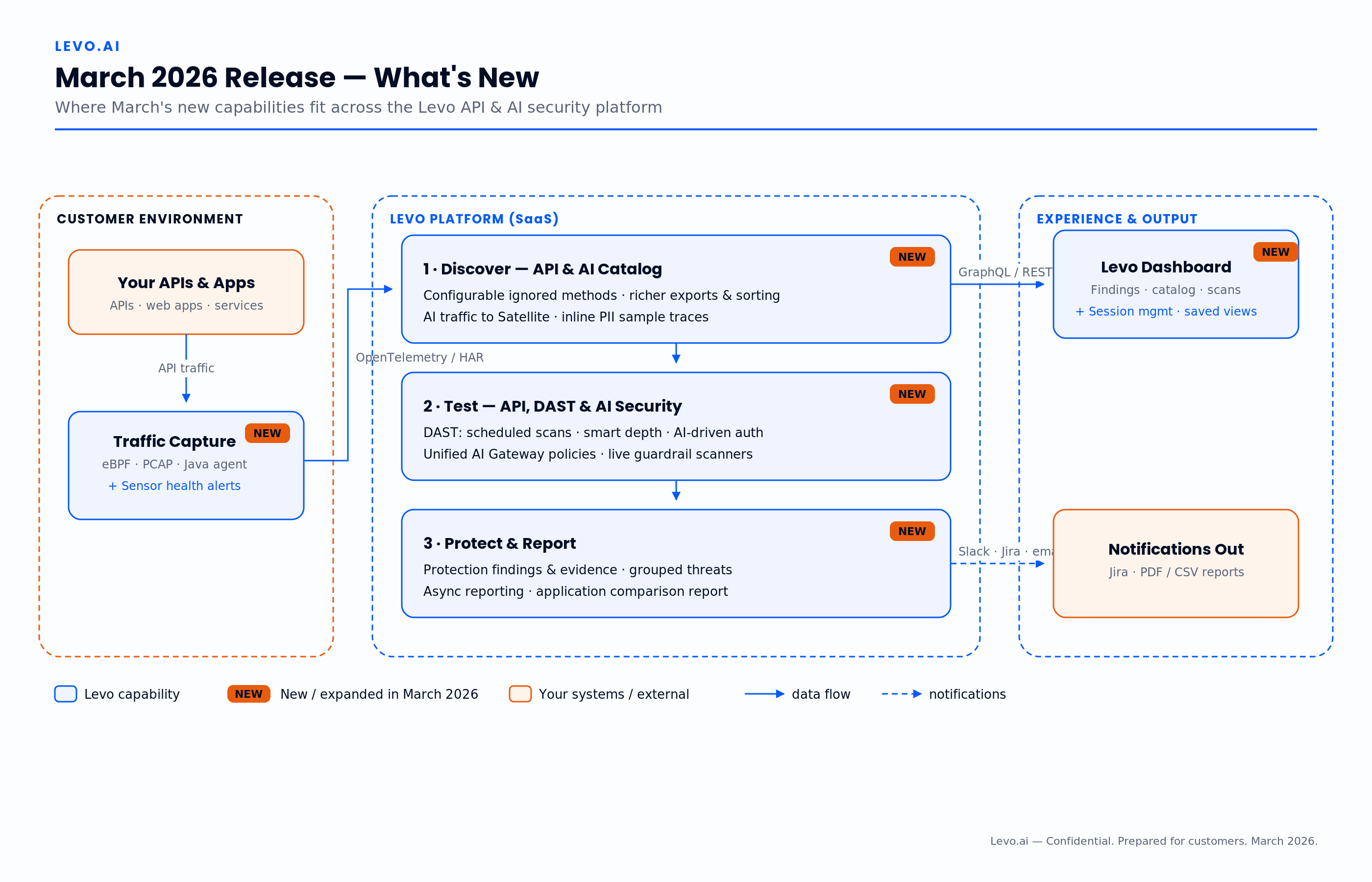
What's new at a glance. A one-page map of where March's additions land across the Levo API and AI security platform.
API Discovery & Cataloging
New Features
- Configurable ignored HTTP methods — API discovery can be configured to skip specific HTTP methods, keeping catalogs focused on the traffic that matters.
- Endpoint exports now include the created date and last-trace-received date, and you can sort endpoints by when their last trace arrived.
- Header parameters such as Content-Type and Accept are now parsed and populated automatically, and endpoint parameters are returned sorted by required status and name.
- A new "Recently Discovered" filter at the application level, and a tooltip on Owned Domains in the API Discovery configuration.
Resolved Issues
- Request parameters wrap incorrectly in API specifications.
- Masked parameters are handled incorrectly in captured request paths.
API Security Testing
New Features
- Live UI log streaming per test suite for better visibility into running tests, and quieter CLI output in non-interactive mode.
Resolved Issues
- User-set parameter values are overwritten by newly derived values, and custom values are not preserved in raw parameters.
- Test-run counts do not match between Insights and the API Scans page.
- Author selection does not use organization users.
Web Application Scanning (DAST)
New Features
- Scheduled and re-runnable web app scans — Schedule web app scans to run automatically, re-run a previous scan, and trigger scans from CI/CD with a new DAST scan action.
- Smart scan depth and crawl-only mode — Scans default to a "smart" depth mode, with a crawl-only option for discovery and configurable scan depth per scan.
- AI/LLM-driven authentication — Provide cookies, local storage keys, and headers for authenticated scans, including AI-assisted login that handles SPA re-login and CAPTCHA flows.
- OpenAPI spec parsing and broader coverage — The scanner parses OpenAPI specs and adds support for the remaining DAST vulnerability categories, plus soft-404 detection, tech-stack detection, and stored-XSS detection.
- Deployable on-prem scan runners — Run web app scans from deployable runners with scheduled, org-isolated execution for on-prem deployments.
- A redesigned create-scan flow, a search bar for URLs and endpoints in the scan details view, HTTP-method support and filtering, live crawl metrics, persistent filters, saved filter state, and the ability to switch off DAST scanning selectively.
- Endpoint URL is now captured on DAST findings and vulnerabilities, with a finding "Kind" filter (Web App Scans / Traffic / All).
Resolved Issues
- Large numbers of false positives across active and passive scanners, including auth-bypass, JWT, GraphQL introspection, and JSON-reflected XSS.
- Crawling is unreliable, static assets are not filtered, soft-404s are mishandled, and scan cancellation does not work correctly.
- The CLI fails to start.
AI Security
New Features
- Unified AI Gateway policy architecture — A consolidated, gateway-level policy framework with a single policy engine, policy versioning, and policies hot-reloaded from SaaS so changes take effect without redeploying.
- Forward-proxy AI traffic governance — A new forward-proxy mode runs AI traffic through a multi-stage governance pipeline for inline inspection.
- Live guardrail scanners in the AI Firewall — Guardrail scanners are now implemented and enabled, with the AI Firewall and AI Gateway pages out of "coming soon."
- Chrome extension AI Guardrails — The browser extension (now "Levo Live") adds AI Guardrails integration with LLM interception and enforce or observe modes.
- The AI Gateway can now send its traffic to the Levo Satellite for full API observability alongside your other APIs, and ships latency benchmarks with inspection optimizations.
AI Discovery
New Features
- AI traffic to the Satellite — The collector adds a Levo AI receiver and AI-proxy span processing, and full LLM request bodies are forwarded so AI agents and MCP entities are discovered accurately.
Vulnerabilities & Findings
New Features
- Grouped threats and evidence — Threats are now grouped for easier triage, with evidence returned by the findings API and surfaced in the Threat Feed.
- Bulk tag actions — Apply tag actions to findings in bulk, and sort findings by severity.
- More filters on the Findings and Applications pages, saved filters and views on API Scans, application stats that update as you apply filters, and a stats API for consistent counts.
Resolved Issues
- Open-vulnerability counts do not match between Insights and the global level.
- Bulk actions on the vulnerability pages do not work correctly.
Sensitive Data
New Features
- Inline sample traces for PII — The PII tab now shows inline sample traces with row selection, pagination by type, and a refreshed view that updates as new sensitive data is discovered.
Runtime Protection
New Features
- Findings and evidence from protection rules — Protection now creates findings (including for Lua-based rules) with evidence, and deduplicates rate-limit findings to one per key per window.
- Bulk rule exclusions and header-injection rules — Add bulk rule exclusions and custom header-injection rules, with configurable content types and active WAF protection.
- Improved rate-limit rule configuration in the dashboard, and GraphQL protection handling.
- Blocking is now disabled by default for safer rollout, with smarter routing of rule overrides and hardened Kubernetes deployment.
Sensors & Deployment
New Features
- Sensor health notifications — Get notified when a sensor becomes inactive, with configuration support so you always know your traffic capture is healthy.
- The Java agent now logs to file with additional diagnostics for easier troubleshooting.
Resolved Issues
- A customer-reported Sensor Helm chart deployment issue.
Integrations
New Features
- CI/CD DAST scan action — A new action to run web app scans directly from your CI/CD pipeline.
Resolved Issues
- Auth0 tokens are not routed by subject claim.
- SSO-only users get a 401 on password reset.
Reporting & Compliance
New Features
- Application comparison report — A new report that compares applications side by side, available to run and view in the dashboard.
- Async reporting pipeline — Existing reports were migrated to an async architecture for reliability at scale, with additional report types added and a new Reports page in the UI.
- Reports support multiple CSV previews, and DAST scan report findings now include a solution field and detected AI endpoints.
Resolved Issues
- PDFs render incorrectly in generated reports.
MCP Server
New Features
- Reliability improvements to the MCP Server deployment.
Platform, Administration & Access
New Features
- Configurable session management — Set inactivity and absolute session timeouts, with sensible defaults and a banner that explains why a session ended after inactivity or expiry.
- Default "staging" environment — New organizations are created with a default "staging" environment so you can start capturing traffic immediately.
- Redesigned admin portal login — A modernized admin portal sign-in, with consolidated frontend and backend deployment.
- Sidebar UX improvements (peek, pin, and toggle), clicking the Levo logo returns you home, an announcements unread count, and organization list sorting with consolidated copy buttons.
Resolved Issues
- Cross-organization data leaks on organization switch because cached state is not cleared.
- Pagination and filter state are lost across navigation.
- Dark-mode rendering issues.
- Several login and auto-logout bugs.